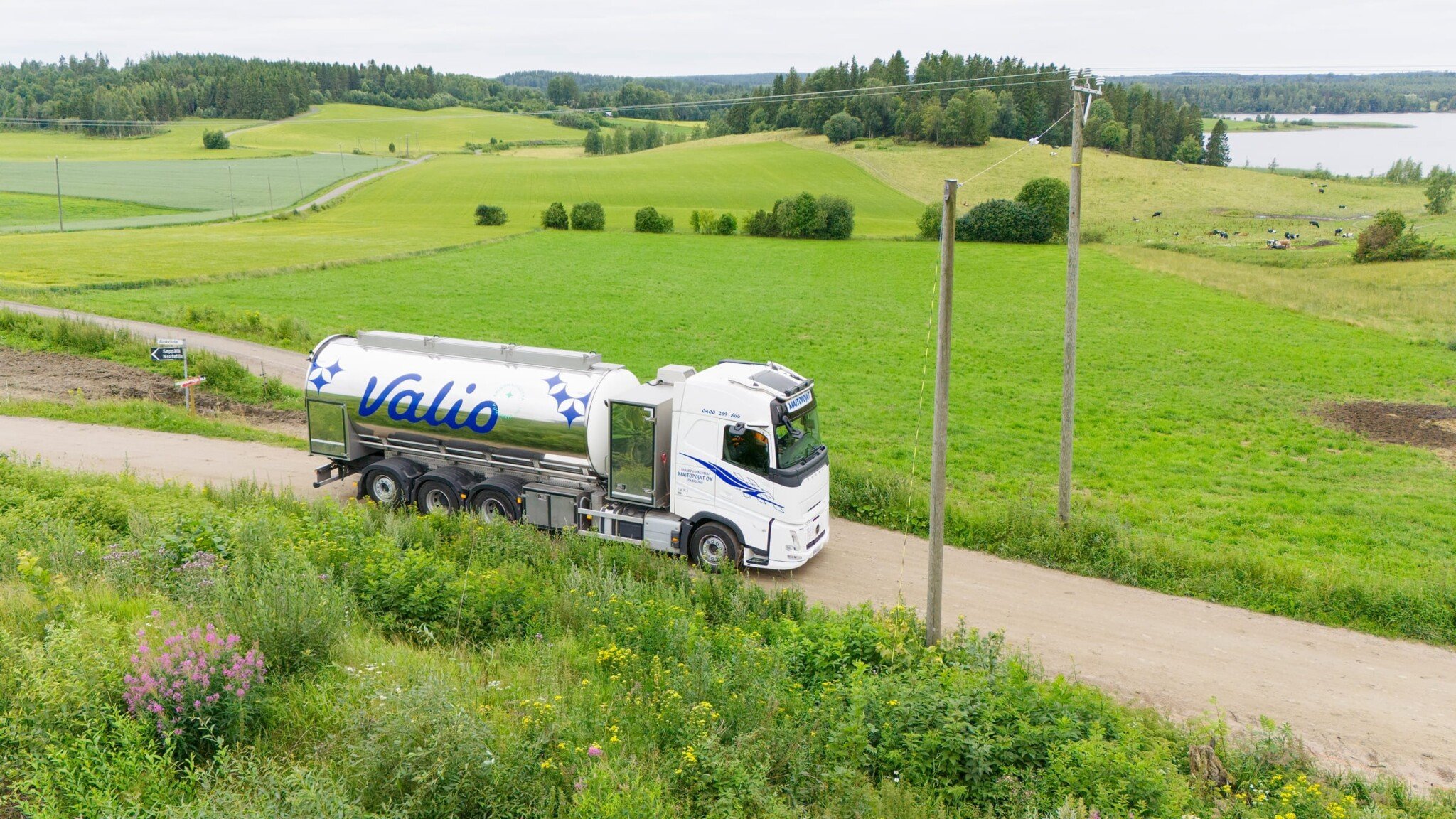
Valio’s transports are on the road around the clock, every day of the year. Valio’s logistics department ensures smooth and reliable transports throughout Finland – from collecting milk from the approximately 3,000 farms to the production plants, to transporting products to warehouses, and delivering them to customers in Finland and to international export markets.
Valio plans its own collection and delivery routes, and the deliveries are made by drivers, who operate as subcontractors. Milk collection from Valio dairy farms in Finland is carried out by some 35 subcontractors and 60 trucks. Distribution of Valio’s products in Finland is handled by 115 transport contractors and 220 delivery trucks.
In 2025, Valio’s distribution in Finland made about 1.5 million customer visits, which means around 5,500–6,500 customer encounters per day, depending on the delivery day.
Renewable fuels on the road
We are reducing transport emissions by gradually transitioning from fossil fuels to renewable alternatives.
Manure biogas: Valio aims to have an increasing number of milk collection and delivery trucks run on biogas. In the future, the biogas used in Valio’s transport logistics may come from dairy farm manure, allowing waste generated in the food production chain to be utilized as part of that same chain. This is the circular economy at its best.
Electrification: We actively monitor developments in electric heavy-duty vehicles, particularly in urban distribution. We simulate the use of electric vehicles, we collaborate with research institutions and educational organizations, and we keep an open mind as we explore the new energy solutions that future logistics may bring.
Ferry traffic: In international transports, fossil-free logistics are promoted by using a ferry service fuelled by liquefied biogas for traffic between Finland and Sweden.
Route optimization and fill rates
The most effective way to reduce emissions is to drive fewer kilometres.
Smart route planning: We use advanced technology and data to optimize the routes of our milk and delivery trucks. The goal is to ensure that the trucks don’t drive a single meter empty or unnecessarily.
Fleet development: We promote and encourage the widespread adoption of more energy-efficient transport fleets that use renewable fuels in close collaboration with transport service providers.
High capacity transport vehicle combinations: We use HCT vehicles that are larger and longer than normal. One HCT vehicle can carry more cargo in a single trip, which reduces the number of trips required and, consequently, emissions per litre.
Fuel-efficient driving
Our drivers play a major role in reducing emissions. We train our drivers in fuel-efficient and proactive driving, which saves fuel, reduces emissions, and improves traffic safety.