Valio’s climate work is based on science and actions
The goal of Valio’s climate programme is to significantly reduce greenhouse gas emissions across the milk value chain. Valio’s does science-based, short and long term work reduce emissions.The programme is being advanced through actions based on the latest Finnish and international research data and monitored using science-based calculations. The aim of Valio’s Climate Programme is to reduce greenhouse gas emissions caused by milk production and to increase carbon sequestration in, e.g., arable land.
In line with our Climate Programme, we are significantly reducing greenhouse gas emissions while increasing carbon sequestration in grasslands. Through concrete measures, emissions are reduced:
on dairy farms
in transportation and logistics
in our own production
through packaging development
The Climate Programme covers approximately 90 percent of all Valio Group emissions. The Climate Programme includes Valio Finland’s emissions, excluding wholesale products, capital investments, emissions from primary fuel production, electricity transmission losses, and the storage, use, and disposal of sold products.
What the Climate Programme covers
The Climate Programme covers emissions from all categories in the milk value chain (Scope 1, Scope 2, and Scope 3), and the emissions it accounts for in Valio’s value chain ends with product deliveries to customers. In addition, from the beginning, the programme has included land use-related soil emissions and sinks.
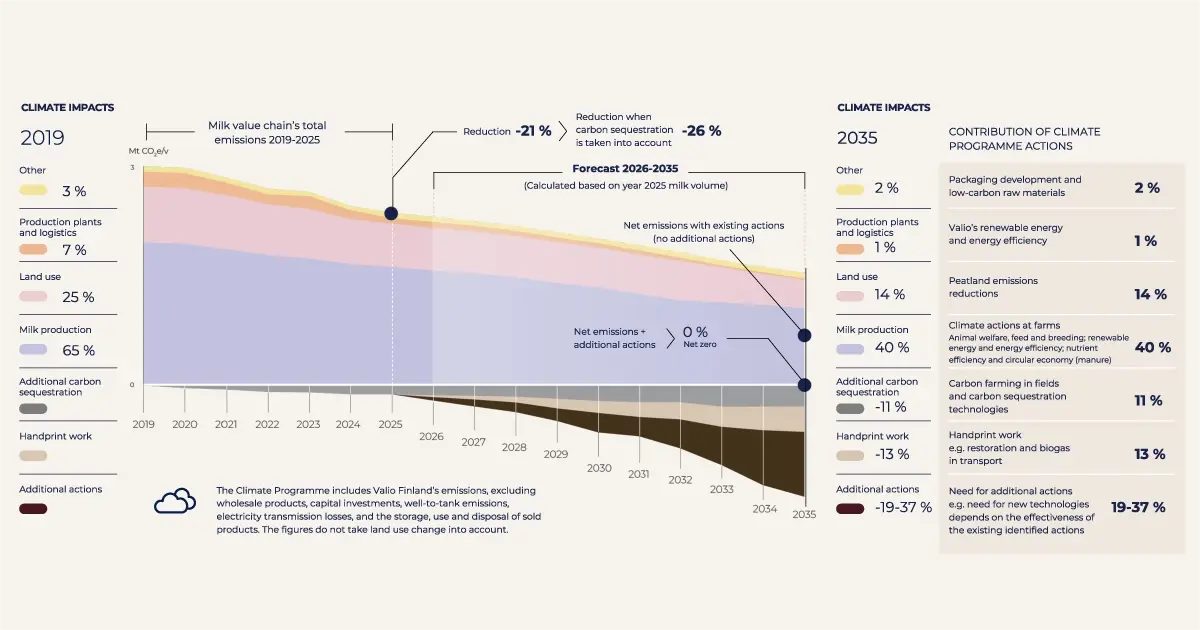
Valio’s Climate Programme has clear targets and concrete actions for achieving a emission reduction targets in the milk value chain. There are around 40 identified actions, some of which are already in use and some are still in the development phase. Additional actions are still needed to achieve the target, and actively exploring these is part of the Climate Programme. We have outlined specific measures for achieving the target in our sustainability report. We monitor the progress of our Climate Programme annually and report on its progress in our sustainability report.
Approximately 90 percent of the milk value chain’s emissions are generated on dairy farms, so emission reduction actions are focused on primary production. Production plants and worksites account for seven percent of emissions. Packaging accounts for approximately one percent of Valio’s carbon footprint and logistics for two percent.
Breakdown of emissions covered by Valio’s Climate Programme
Emissions from the Finnish milk value chain, including land use related to milk production (~2,3 Mt CO2e).
Raw milk
68%
Land use
25%
Factories and logistics
4%
Other
3%
The Climate Programme is based on scientific knowledge and innovations
Valio’s Climate Programme’s actions and their commercialization have been integrated into Valio’s business strategy from 2024 onwards. Valio’s Climate Programme and its target of a carbon-neutral milk value chain are approved by Valio’s Executive Board and the Board of Directors.
In Valio’s Climate Programme, the calculation of emissions and carbon sinks is based on the latest scientific knowledge and innovations. Valio uses these calculations to monitor its emissions and the progress of the Climate Programme across its value chain, from dairy farms to store shelves. The Climate Programme is updated annually, and actions in line with it will continue in accordance with the strategy.
Climate Programme’s calculations start with 2019
The Climate Programme was launched when Valio, following the release of the IPCC’s Fifth Assessment Report, assessed the impacts of climate change on its core business, namely milk production, the production of dairy products, and marketing and sales.
Following a strategy review, in 2017–2018 it was decided to start preparing a Climate Programme focused on the milk value chain. The programme was published in November 2018. The Climate Programme’s calculations start with 2019.
Valio is additionally committed to science-based SBTi climate targets for 2030, in line with the Paris Agreement.